
“Doctor, should I do a root canal or extraction?”
I hear this question almost every day. Usually, it comes with a worried look, a hand hovering near the cheek, and a quiet hope that I’ll say, “Don’t worry, we’ll just pull it out and be done.”
I understand the confusion. When you’re in pain, both options can sound equally intimidating, and Googling root canal vs extraction rarely makes things clearer. One article says extraction is faster. Another says root canals are painful. Someone’s cousin had a terrible experience in 2009, and now everyone’s scared.
Let me explain this properly, without jargon, drama, or scare tactics.
With over 27 years of clinical experience, my philosophy has always been simple:
If a natural tooth can be saved safely, it’s usually worth saving.
But there are times when extraction is the better choice, and I’ll tell you honestly when that’s the case.
By the end of this article, you’ll know:
- Is a root canal or extraction better for you
- What actually happens in both procedures
- The real differences in pain, cost, and long-term impact
And hopefully, you’ll feel calmer than when you started reading.
Key Takeaways
- Root canal treatment is usually preferred because it saves your natural tooth.
- Tooth extraction is recommended only when the tooth cannot be saved safely.
Pain is not the deciding factor; modern dentistry makes both procedures comfortable. - Extraction may seem cheaper at first, but replacing a missing tooth often costs more in the long term.
- An untreated infection is worse than either a root canal or an extraction.
Root Canal vs Extraction – What Actually Happens?
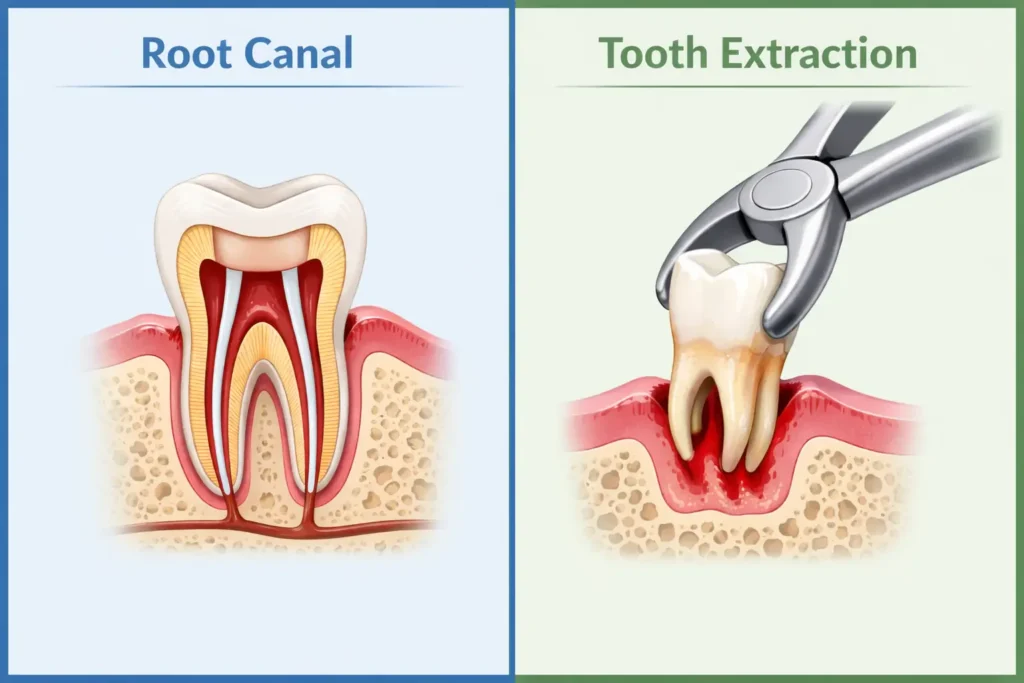
Let’s demystify both options. No horror stories. No dramatic music in the background. Just facts, with a little calm commentary from me.
What Is a Root Canal Treatment?
Root canal treatment is a dental procedure that removes infected or damaged pulp from inside a tooth, cleans and disinfects the root canals, and seals them to stop further infection.
The treatment allows the natural tooth to remain in place, restoring normal function such as chewing and maintaining the surrounding jawbone and bite alignment.
When do you usually need a root canal?
- Deep decay has reached the nerve
- A cracked or heavily filled tooth
- Infection causing ongoing pain or sensitivity
Swelling, abscess, or that “something’s not right” feeling
What happens during a root canal? (Step by step)
- Local anaesthesia – you’ll be comfortably numb (yes, really)
- Infected tissue is removed – the troublemaker is evicted
- Canals are cleaned and disinfected – very thoroughly
- The tooth is sealed – no room for bacteria to move back in
A crown may be recommended – think of it as a protective helmet
Recommened Reading: What Happens If You Don’t Get a Root Canal?
Aftercare
- Mild tenderness for a day or two is normal
- Most patients go back to work the same day
Many say, “That was much easier than I expected” (my favourite review)
What Is a Tooth Extraction?
A tooth extraction means removing the entire tooth from the jaw.
Sometimes, despite our best efforts, a tooth simply can’t be saved, and that’s when extraction becomes the sensible option.
When is extraction necessary?
- The tooth is too broken to restore
- Severe infection with poor bone support
- Advanced gum disease
Vertical root fractures (these are sneaky and unfixable)
What happens during an extraction? (Step by step)
- Local anaesthesia – again, you’ll be numb
- The tooth is gently loosened – no wrestling matches involved
- The tooth is removed – carefully and cleanly
- The area is cleaned – to allow proper healing
Healing begins – gum and bone gradually settle
What happens after the tooth is removed?
- The space remains unless replaced
- Bone can slowly shrink over time
- Nearby teeth may start drifting (they like to wander)
Root Canal vs Tooth Extraction: Which Is Better?
Whether a root canal or extraction is better depends on the condition of the tooth, the severity of infection, and your long-term oral health goals.
That said, in most cases where the tooth can be saved safely, a root canal is usually the better option than tooth extraction because it preserves your natural tooth and prevents future dental complications.
Root Canal vs Tooth Extraction: Side-by-Side Comparison
| Factor | Root Canal Treatment | Extraction |
| Purpose/ Objective | Save the natural tooth by removing the infection | Remove a tooth that cannot be saved |
Pain During Treatment |
Similar to getting a filling with modern anaesthesia | Preserves bite, jawbone, and tooth alignment |
| Recovery Time | Quick, usually 1–2 days | Slightly longer due to healing of bone and gums |
| Cost | Higher upfront | Lower upfront |
| Long-Term Impact | Preserves bite, jawbone, and tooth alignment | May lead to bone loss and shifting of nearby teeth |
| Tooth Preservation | Yes | No |
So, Should I Do a Root Canal or Extraction?
If the tooth structure is strong enough and the infection can be controlled, a root canal is almost always preferred over extraction.
Extraction is recommended only when:
- The tooth cannot be restored
- Infection has destroyed the supporting bone
- The tooth is structurally unsalvageable
Still unsure whether a root canal or extraction is right for your tooth?
That’s completely normal. This decision shouldn’t be made based on guesswork or Google horror stories.
A proper examination and X-ray can tell us, very clearly, whether your tooth can be saved or not.
Book an Appointment and let’s decide calmly, safely, and without pressure.
Is a Root Canal or Extraction More Painful?
A root canal is less painful than a tooth extraction; both procedures are done under modern local anaesthesia and are designed to remove pain, not create it.
During treatment, you should feel pressure, not pain. Most of you will even be surprised by how calm and controlled the experience actually is.
After the procedure:
- Mild soreness or tenderness is normal for 1–3 days
- Root canal discomfort usually feels like a bruised tooth
- Extraction may feel slightly sore for a little longer as the bone and gums heal
What actually causes more pain?
- Leaving a dental infection untreated
- Waiting until swelling or an abscess develops
- Choosing based on fear instead of diagnosis
Most patients usually tell me the same thing again and again:
“The pain before treatment was much worse than the root canal or extraction.”
Cost Comparison: Root Canal vs Tooth Extraction in Singapore
Let’s talk about cost, without panic, calculators, or worst-case assumptions.
At first glance, tooth extraction usually looks cheaper, while a root canal can seem like the more expensive option. And yes, that’s often true.
But dentistry is a long-term game, not a one-day decision.
Here’s what often gets missed in the root canal vs tooth extraction cost conversation:
- A root canal is a one-tooth, one-problem solution aimed at saving what you already have
- An extraction removes the tooth… but often creates a new problem to solve later
After an extraction, many of you will eventually need:
- A dental bridge
- A denture
- Or an implant (which I don’t place, because my focus is helping you avoid needing one in the first place)
Once replacement options enter the picture, the long-term cost of tooth extraction often exceeds the cost of saving the tooth with a root canal.
My philosophy is simple:
If a tooth can be saved safely and predictably, it’s usually more cost-effective, financially and biologically, to keep it.
Pros and Cons of Root Canal vs Tooth Extraction
When patients ask me, “Should I do a root canal or extraction?” This is usually the part that helps everything click.
There’s no sales pitch here, just an honest look at the root canal vs extraction pros and cons, so you can decide with clarity.
Root Canal – Pros
- Saves your natural tooth, which is almost always the best long-term outcome
- Maintains normal chewing and bite balance
- Helps prevent jawbone shrinkage over time
- Keeps neighbouring teeth stable and aligned
Avoids future tooth replacement costs, improving the root canal vs tooth extraction cost equation in the long run
Root Canal – Cons
- Slightly higher upfront cost compared to the extraction
- May require a crown to protect the tooth afterward
- Not suitable if the tooth structure is too damaged to save
Tooth Extraction – Pros
- It can be a quick solution when the tooth truly cannot be saved
- Necessary in cases of severe infection, fracture, or advanced gum disease
Lower initial cost, which is why many people assume extraction is better
Tooth Extraction – Cons
- Permanent tooth loss, there’s no undo button
- Leads to bone loss in the jaw over time
- It can affect chewing, bite alignment, and neighbouring teeth
- Often results in additional future costs for bridges, dentures, or implants
- In the root canal vs tooth extraction pain discussion, post-extraction discomfort can last longer due to healing and bone changes
Why Dentists Often Recommend Saving the Tooth
If a tooth can be saved safely, most dentists will recommend doing so, and there’s a very simple reason for that: nothing works quite like your natural tooth. Once a tooth is removed, it’s gone for good.
Extraction is irreversible, while a well-done root canal preserves what your body originally built.
From a long-term perspective, saving the tooth usually offers better function, stability, and comfort than removing it.
Benefits of keeping your natural tooth:
- Better chewing efficiency: Natural teeth handle biting forces better than any replacement
- Healthier jawbone: Tooth roots stimulate the jawbone and help prevent bone loss
- Stable bite and alignment: Keeping the tooth prevents nearby teeth from shifting
- More predictable long-term outcome: Fewer changes to your bite over time
- No urgency for replacement: Avoids the need for bridges, dentures, or implants later
In the root canal vs extraction discussion, preserving the tooth is often the option that protects your oral health for the long run, not just solves today’s problem.
How Dentists Decide Between Root Canal or Extraction
No coins are flipped. No magic 8-balls are consulted.
This decision is very clinical, just delivered calmly and without panic.
Before recommending a root canal or extraction, I run through a very real checklist to see whether saving the tooth is sensible, safe, and predictable long-term.
Here’s what I assess:
- Remaining tooth structure: Is there enough healthy tooth left to restore?
- Extent of infection: Is it localised, or has it spread beyond the root?
- Gum health: Healthy gums support long-term success.
- Bone support: The tooth needs a solid foundation (even teeth need good real estate).
- Cracks or fractures: Vertical cracks usually end the conversation.
- Bite forces: Heavy grinding or clenching changes the plan.
- Patient habits: Oral hygiene, follow-ups, and whether you’ll actually come back for the crown.
If the tooth can be saved predictably, I’ll recommend saving it.
If it can’t be kept it would cause more problems later, extraction becomes the wiser option.
That’s why the question “Should I do root canal or extraction?” never has a one-size-fits-all answer.
It always comes down to a personalised assessment, not a rushed decision.
Why Choose Dr. Prashanth for Your “Save the Tooth” Mission?

I’ve been practising dentistry for 27+ years across the UK, Australia, and Singapore, and I’ve treated 10,000+ patients, including plenty who openly admit they hate dentists.
When it comes to root canal vs extraction, my approach is simple:
If a tooth can be saved safely and predictably, I’ll always try to save it. I explain the pros, cons, pain, and long-term impact clearly, so you can decide without fear or guesswork.
Still unsure whether a root canal or extraction is right for you?
Let’s assess your tooth properly and decide calmly; no pressure, no panic.
FAQs
Which is safer, a root canal or extraction?
The main difference between a root canal and extraction is tooth preservation. A root canal is safer when the tooth can be saved because it removes infection while preserving the natural tooth and jawbone. Extraction is used only when the tooth cannot be repaired predictably.
If you’re unsure which option applies to your tooth, a clinical assessment makes the decision clear. Book Your Appointment Now!
How long does a root canal last?
A properly performed root canal can last 10–20 years or longer. With a good filling or crown and normal oral hygiene, many root canal–treated teeth last as long as natural teeth.
Will extraction change my face shape?
Yes. Tooth extraction can change facial shape over time if the tooth is not replaced. Bone loss in the jaw reduces support for the lips and cheeks, especially when multiple teeth are missing.
What hurts more, extraction or root canal?
Neither hurts during treatment because both procedures use local anaesthesia. Most patients report that infection-related pain before treatment is worse than discomfort from either a root canal or an extraction.
How do I know if I need extraction?
Extraction is needed when a tooth is too broken, has severe bone loss, or has an irreparable fracture. Dentists decide this using X-rays, clinical examination, and long-term predictability of saving the tooth.
Is a tooth extraction faster than a root canal?
Yes, tooth extraction is usually faster than a root canal. However, extraction often leads to additional treatments later, while a root canal solves the infection and keeps the tooth functional.

Dr. Prashanth Kanakamedala (BDS, MDS) is a Senior Dentist in Singapore with over 27 years of experience across the UK, Australia, and Singapore. Trusted by 8,500+ patients, he’s known for his gentle approach and dedication to helping every patient achieve a healthy, confident smile.